Disabled Vehicles Transported Without Further Damage
Light and Medium Towing in Lyons for passenger vehicles, SUVs, pickup trucks, vans, motorcycles, and medium-duty vehicles
A breakdown on a rural highway or a collision at an intersection leaves drivers stranded with limited options and mounting concerns about how their vehicle will be moved without causing additional harm. Santiam Towing and Recovery responds to these situations with operators trained in safe loading procedures that protect suspension components, body panels, and drivetrain systems during transport to repair facilities or customer-selected destinations. Proper towing begins with understanding how each vehicle's weight distribution, drivetrain configuration, and existing damage affect loading and securing methods.
Towing services for passenger vehicles and medium-duty trucks require operators to assess whether the vehicle can roll freely, whether all wheels are intact, and whether the drivetrain is in neutral or park before selecting a tow method. Flatbed transport eliminates ground contact entirely, which prevents transmission damage on all-wheel-drive vehicles and avoids further stress on vehicles with suspension damage, while wheel-lift towing works for rear-wheel-drive vehicles with functional rear axles and no undercarriage obstructions.
Schedule towing services as soon as your vehicle is disabled to arrange transport that matches your vehicle's specific condition and your destination preference.
What Proper Towing Requires
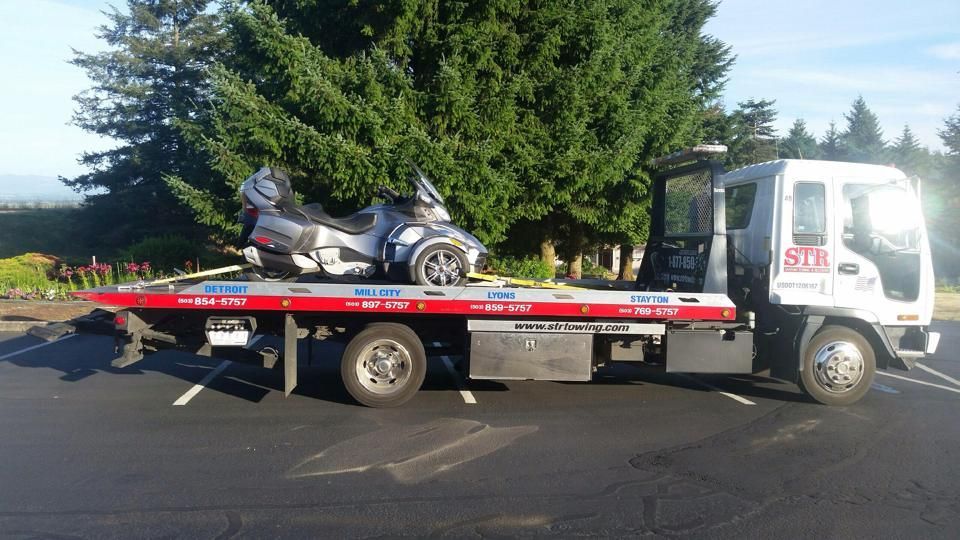
Operators verify that safety chains are attached to structural mounting points, not plastic bumper covers or exhaust components, and that tire straps or wheel cradles are positioned to distribute pressure across the tread rather than concentrating force on a single point that could damage the wheel or tire sidewall. For motorcycles, specialized cradles stabilize the bike without leaning it at angles that could cause fuel or oil leaks.
After your vehicle is delivered, you'll see that it arrives in the same mechanical condition it was in when it was loaded, with no new scratches from dragging, no transmission warning lights caused by improper towing of all-wheel-drive systems, and no bent suspension arms from incorrect lift points. These outcomes separate experienced operators from those who treat every vehicle the same regardless of drivetrain or damage severity.
Santiam Towing and Recovery transports vehicles to repair shops, impound yards, or private property throughout Lyons and the surrounding region. Service includes documenting pre-existing damage with photos, coordinating with insurance adjusters when requested, and confirming delivery instructions before departure to avoid miscommunication about destination or special handling requests.
Answers to Frequent Service Questions
Drivers facing their first towing experience often have concerns about how the process works and what they should expect from start to finish.
What information does the operator need when dispatched?
Operators need your exact location with mile markers or cross streets, the vehicle make and model, whether the vehicle can roll or shift into neutral, and whether there is front-end damage, flat tires, or other visible issues that affect loading method selection.
How is a motorcycle loaded onto a tow truck?
Motorcycles are rolled onto a flatbed using a ramp, secured in an upright position using a wheel chock and multiple tie-down straps attached to handlebar mounts or frame points, and transported without leaning to prevent fuel or fluid leaks during transit.
Why does drivetrain type matter for towing?
All-wheel-drive and four-wheel-drive vehicles can suffer transmission or transfer case damage if towed with any wheels on the ground, because the drivetrain continues to turn components that are not being lubricated when the engine is off, which is why flatbed transport is preferred for these configurations.
When should a vehicle be towed instead of driven after an accident?
Towing is necessary when fluid leaks indicate compromised cooling, braking, or steering systems, when tire damage exposes belts or sidewall cords, or when warning lights suggest that driving could cause engine or transmission failure that turns a repairable problem into a total loss.
What areas around Lyons are covered for towing?
Service covers Highway 22 corridors, rural roads throughout the Santiam Canyon, and connections to nearby communities where repair facilities and storage yards are located, ensuring that vehicles are transported to the closest appropriate destination based on customer preference and facility availability.
Santiam Towing and Recovery approaches each towing assignment with attention to vehicle-specific requirements and customer-defined outcomes. Call to arrange transport that prioritizes safe handling and clear communication from dispatch through delivery.